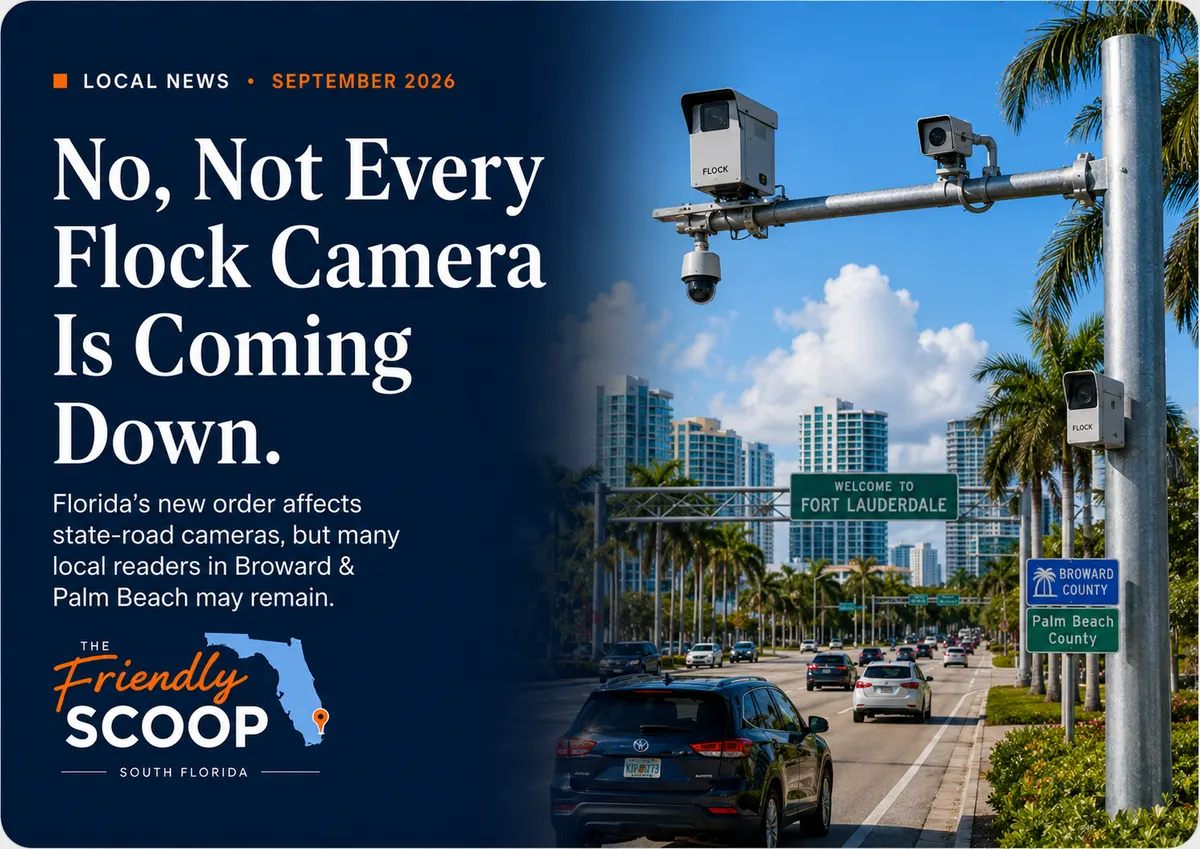
No, Not Every Flock Camera Is Coming Down: What Florida's New Order Actually Does in Broward and Palm Beach
The state revoked every license plate reader permit on state roads effective August 31. That covers a fraction of the cameras in our two counties. Here is what it reaches, what it does not, and where each local agency stands.
Jump to a section
- The short answer
- What the order actually says
- Which roads near you are state roads
- What these cameras actually collect
- Broward County, city by city
- Palm Beach County, city by city
- The local silence is itself the story
- The two arguments, as each side makes them
- What happens next
- What we could not confirm
- How to check for yourself
- Sources
- Stay Updated & Explore
- Frequently Asked Questions
If you drive in Broward or Palm Beach County, you pass license plate readers constantly. They are the small dark boxes on slim poles at intersections, along arterials, at the entrances to gated communities and shopping plazas. Most people call them Flock cameras, after Flock Safety, the Atlanta company with the best known version. Axon and Motorola Solutions sell competing systems that look and work much the same way.
On Monday, August 31, the state acted for the first time. The coverage since has left many people with the impression that all the cameras are coming down. That is not what happened.
To be precise about what this is: it is not a statewide ban on automated license plate readers, and it does not prohibit Florida law enforcement agencies from using the technology generally. It is a permitting action by the Florida Department of Transportation governing fixed installations in State Highway System rights of way. It also does not require any agency to delete plate data it has already collected.
📩 Stay in the Loop with The Friendly Scoop
Join locals who love discovering the best of South Florida. Every month we deliver the freshest events, hidden gems, dining spots, and neighborhood news straight to your inbox, free.
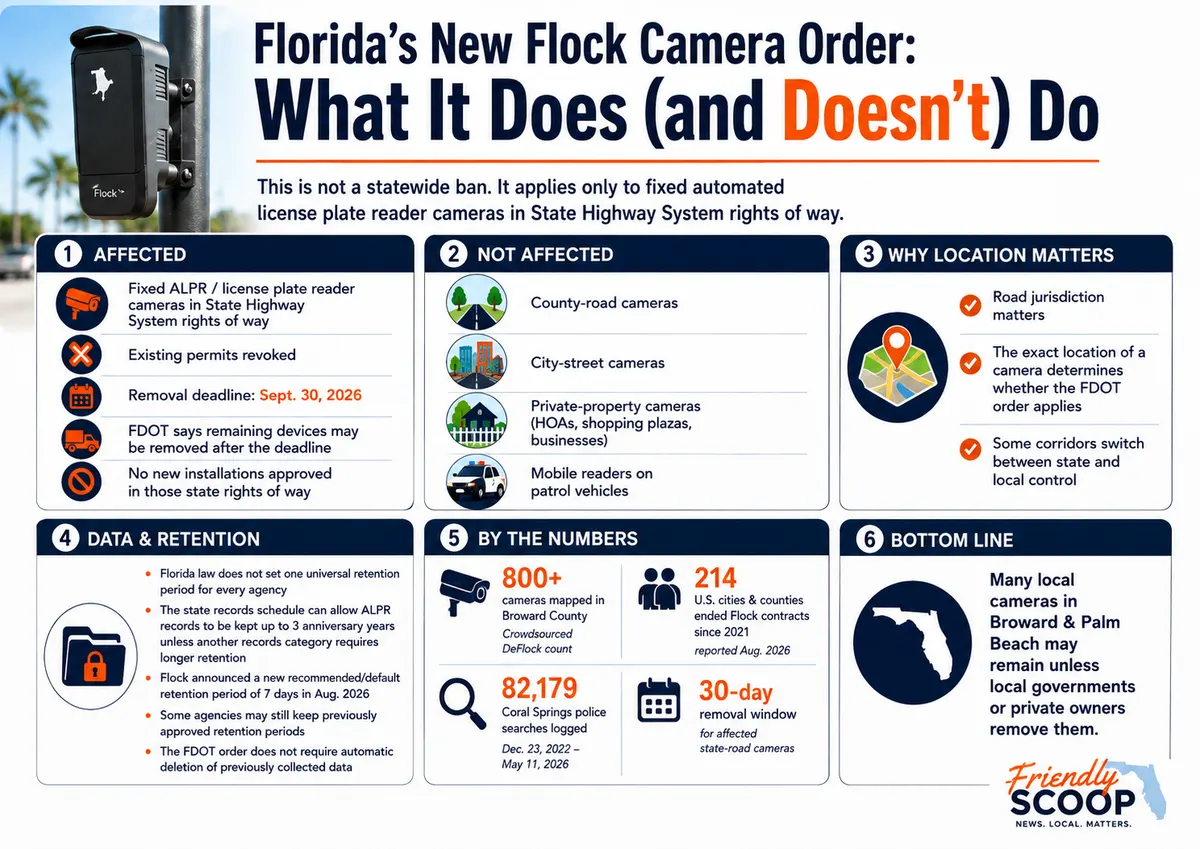
Whether a camera comes down depends on who maintains the road it sits on.
The short answer
Many, and likely most, cameras in Broward and Palm Beach County are not affected.
The Florida Department of Transportation controls the State Highway System. It revoked permits for readers sitting in those rights of way, and only those. Sort the cameras into four buckets:
| Where the camera is | Status |
|---|---|
| In a state highway right of way | Must be removed by September 30, 2026 |
| On a county road | Not covered. Stays unless the county acts |
| On a city street | Not covered. Stays unless the city acts |
| On private property: HOA entrance, shopping plaza, business | Not covered at all |
Mobile readers, the kind mounted on patrol vehicles and used by agencies including the Florida Highway Patrol, are also outside the order.
There is no official inventory of how many local cameras sit in a state right of way, so "most" is an inference rather than a count. It is a well supported one: Governor Ron DeSantis estimated Florida has roughly 7,500 readers and said the large majority sit on local rather than state roads.
So the honest framing is this: the state removed cameras from the roads it controls and left the remaining decisions to local governments, law enforcement agencies and private property owners.
What the order actually says
FDOT issued Engineering and Operations Memorandum No. 26-01, signed by Will Watts, the department's chief operating officer and assistant secretary. It does three things:
- Revokes every existing permit for automated license plate recognition systems placed by local law enforcement in State Highway System rights of way.
- Directs agencies to remove them, a deadline of September 30, 2026. FDOT says it will remove whatever remains.
- Stops FDOT from approving any new reader installations under its jurisdiction, effective immediately.
FDOT also reserved the right to pull any individual device sooner if it creates a safety hazard.
The stated reasoning, quoted from the memo, is that the recent exponential increase in deployments along state roadways, coupled with "reports of misuse, data privacy concerns, and surveillance schemes," merits immediate action to preserve Floridians' sovereignty and quality of life. No specific agency, vendor, incident or location is named.
The 30 day clock is not FDOT's invention. Section 316.0777 of the Florida Statutes already says that a reader in a state right of way must be removed within 30 days after FDOT notifies the requesting agency that removal must occur. The same statute puts these installations in FDOT's discretion in the first place, which is the authority the department used to revoke the permits. Two other provisions of that statute are worth knowing: readers in state rights of way may be installed only for collecting active criminal intelligence or active criminal investigative information, and they may not be used to issue a traffic citation. Removal is at the requesting agency's sole expense, so the cost of taking these down falls on local budgets, not the state's.
The memo is vendor neutral, so it covers Axon and Motorola devices too, not only Flock. And because the revocation was a discretionary decision delivered by memorandum rather than a change in state law, a future administration could exercise that same discretion differently.
Which roads near you are state roads
This is the whole ballgame, and it is less obvious than it sounds. Clear examples locally:
| Local name | State designation |
|---|---|
| I-95 | State Road 9 |
| Florida's Turnpike | State Road 91 |
| Sawgrass Expressway | State Road 869 |
| US 441 | State Road 7 |
| Federal Highway / US 1 | State Road 5 |
| Powerline Road, Broward County portion | State Road 845 |
| Sunrise Boulevard | State Road 838 |
| Broward Boulevard, most of its length | State Road 842 |
| Glades Road, US 441 east toward Federal Highway | State Road 808 |
| Palmetto Park Road | State Road 798 |
| Yamato Road, Military Trail to Federal Highway | State Road 794 |
| Atlantic Avenue, Delray Beach | State Road 806 |
| Boynton Beach Boulevard | State Road 804 |
Here is the catch. Several corridors change hands mid route, and the road you think is a state road may not be one where you drive it:
- Powerline Road is State Road 845 in Broward County only. In 2017 the Palm Beach County Commission approved a transfer relinquishing the Palm Beach portion to county maintenance, moving the state route's northern terminus to the county line at the Hillsboro Canal. Powerline through Boca Raton is a county road.
- Sample Road is State Road 834 for about 9.5 miles and County Road 834 for the remaining 2.9 miles.
- Atlantic Boulevard is State Road 814 for roughly 7 miles and County Road 814 for the other 6.
- University Drive is State Road 817 up to Sample Road and carries no state designation north of there.
- Oakland Park Boulevard and Commercial Boulevard have the same kind of state and county split.
- Military Trail is mostly County Road 809 in Palm Beach County, with only a portion designated State Road 809, and the Broward County section carries neither designation.
- Wiles Road is a Broward County road maintained by Broward Public Works, not part of the State Highway System.
If you want to know whether one specific camera is affected, the road's jurisdiction at that exact spot decides it. Broward County publishes a road jurisdiction map showing the responsible agency for each major road, linked in Sources.
What these cameras actually collect
A reader photographs every vehicle that passes, converts the plate to text, and logs it with date, time and location. Systems also capture vehicle characteristics: make, model, color, and distinguishing features such as roof racks, dents or bumper stickers, which allows searches even without a plate number.
Every vehicle is logged, not only vehicles connected to a crime. That is the design, and it is the crux of the disagreement.
Under Florida law, the images and any personal identifying information the systems generate are confidential and exempt from public records release.
On how long the data is kept, there is no single number. Florida law does not impose one universal retention period on every agency. The state's records schedule generally caps standalone license plate recognition records at three anniversary years unless they become part of another record series that requires longer. Flock historically used a 30 day default, but in August 2026 the company announced a new recommended default of seven days, with existing customers keeping their previously approved periods unless they opt in. So the real answer depends on your agency's own policy and contract, which is a public record you can request.
Broward County, city by city
A note on sourcing. Camera counts come mostly from DeFlock and the Electronic Frontier Foundation's Atlas of Surveillance, both crowdsourced projects that mark most entries unverified and that change constantly as users add locations. The spending and vote figures below come from Deflock Broward, a volunteer records project that states plainly that it advocates for removal. The underlying documents it cites are public records, but the framing is advocacy. Treat both accordingly. Countywide, DeFlock listed more than 800 Broward cameras in August, with tallies passing 860 by the end of the month.
Coral Springs. DeFlock lists more than 80 cameras, and local reporting says they now cover all major roads in and out of the city. The expansion was supported by a $500,000 state appropriation requested through a local funding initiative sponsored in the Senate by Tina Polsky, with the request describing support for cameras and license plate readers feeding the department's Real Time Crime Center. The commission voted unanimously in November to accept it. At the June 17 commission meeting, lifelong resident Louis DeSantis asked the city to cancel its Flock contract, saying residents should be able to travel without being surveilled constantly. Commissioner Joe McHugh, a former law enforcement officer, defended the program, citing fugitives, homicide suspects, stolen vehicles and missing people located through the system. In July the police department issued a public "myth versus fact" statement saying readers capture plates and vehicle characteristics to identify vehicles connected to reported crimes, do not identify drivers or passengers, and are not used to monitor daily activity, with access restricted to authorized personnel under department policy. It drew heavy public criticism and did not specify camera count, retention period, or where the governing policy could be reviewed. According to Have I Been Flocked, which compiles agency search logs through records requests, Coral Springs police ran 82,179 searches by 96 individuals across 1,236 days between December 23, 2022 and May 11, 2026. The site's records indicate most queries were broad, often a month of captures across more than 6,000 cameras.
Fort Lauderdale. Deflock Broward documents more than $5.1 million in police ALPR spending from FY2011 through FY2026, and says the commission never voted on enrollment in either surveillance network the department joined, Vigilant LEARN in 2014 or Flock Safety in 2022. It also flags $568,000 in Flock commitments that never appeared on an agenda, including one for $499,996 structured as five annual payments of $99,999.20, each 80 cents below the commission approval threshold. As of August the department confirmed it was executing a new agreement with Flock. Two cameras in Croissant Park were cut down, melted and slashed in July, roughly $6,000 in damage, no arrests.
Hollywood. Deflock Broward documents more than $5.5 million in ALPR spending from 2014 through 2025, with roughly three quarters of about 27 ALPR votes passing on the consent agenda and two staff presentations in eleven years. It says the department's plate data reaches three counties through memoranda of understanding whose titles do not mention license plates.
Pembroke Pines. Roughly $1.3 million in commission-authorized ALPR spending between 2015 and 2025 across 13 or more votes, all on the consent agenda, all unanimous. The project reports no commissioner spoke on an ALPR item in ten years.
Davie. More than $695,000 across 13 purchase orders between 2019 and 2025, with the project reporting six years of operation and no Town Council authorization vote. Privacy advocates organized a rally opposite a camera at a Davie intersection in August.
Weston. 48 cameras positioned to cover every road in and out of the city. That is unusual: full perimeter coverage rather than targeted placement.
Broward Sheriff's Office. As of the most recent reporting, BSO had not publicly announced whether or how it will comply with the FDOT directive.
Palm Beach County, city by city
Boca Raton Police. Listed at 286 license plate reader devices plus roughly 625 static cameras, with automated readers in use since 2011. That figure is single sourced and unverified. The city has not said publicly how many devices sit in state rights of way. Note that Powerline Road through Boca is county maintained, so readers along it are not reached by the FDOT order.
Palm Beach County Sheriff's Office. Listed at 83 devices, alongside a real time crime center, gunshot detection and drone programs. Sheriff Ric Bradshaw responded to the FDOT order directly, telling CBS12 that safeguards preventing abuse are appropriate for any law enforcement technology, but that readers have become indispensable and lead to significant arrests of dangerous suspects. He is one of the few South Florida agency heads to comment publicly so far.
Boynton Beach. In March the commission considered Resolution R26-047, a proposed Flock Safe City agreement of up to roughly $7.7 million plus a 10 percent allowance over 10 years, covering readers, cameras and drones. The item was postponed to April over oversight concerns, and the final outcome is not confirmed in public reporting. Separately, at its June 16 meeting the commission voted 4 to 1 to approve a drone first responder package built on Axon equipment, after city staff said Boynton had terminated a prior drone contract because the vendor could not deliver within a reasonable time. We have not confirmed from the resolution or minutes whether that termination is connected to the Safe City proposal, and readers should not assume it resolved it.
Lantana. Roughly 20 Flock devices, about $342,200, approved in late 2022.
Royal Palm Beach. 28 Motorola readers, not Flock, at roughly $400,000, placed near intersections. Reporting indicates data flows to a Motorola repossession database, a different sharing arrangement than the Flock network.
Gulf Stream. Seven devices.
Wellington. The village's program began in 2018, when the council voted to fund a Palm Beach County Sheriff's Office proposal for 31 readers at seven locations using Law Enforcement Trust Fund money rather than general revenue. That funding path, using seized asset money, is common statewide and is one reason many of these programs never faced a standalone budget debate.
The local silence is itself the story
Within hours of the FDOT memo, sheriff's offices around Florida issued statements. Some said they would comply and remove affected devices. Several went further and shut down their reader programs entirely, pending action by the Legislature.
South Florida has been quieter. Sheriff Bradshaw's comment to CBS12 is one of the only responses from a Broward or Palm Beach agency head. As of publication, the Broward Sheriff's Office had not said publicly whether it will comply or how many of its devices are affected, and neither had the police departments in Coral Springs, Fort Lauderdale, Hollywood, Pembroke Pines, Davie, Weston, Boca Raton or Boynton Beach.
That leaves a straightforward question any resident can put to their own city: how many of our cameras sit in a state right of way, what will removal cost us, and what happens to them by September 30?
The two arguments, as each side makes them
For the cameras. Agencies describe readers as an investigative tool rather than a surveillance program. The Coral Springs Police Department's position is that readers identify vehicles connected to reported crimes, do not identify drivers or passengers, and are accessed only by authorized personnel under department policy. Commissioner McHugh has pointed to fugitives, homicide suspects, stolen vehicles and missing people found through the Coral Springs system. Sheriff Bradshaw calls readers indispensable and credits them with significant arrests of dangerous suspects, while agreeing safeguards against abuse are appropriate. Flock Safety says that in a survey of nearly 700 law enforcement agencies, more than 40 percent reported the technology was involved in recovering half or more of the stolen vehicles in their jurisdiction, and that new city partnerships have outpaced nonrenewals by roughly 10 to 1 so far in 2026. In August the company announced a package of safeguards: a seven day recommended default retention period, an Evidence Mode for preserving data tied to active cases, offense-based limits on what outside agencies can search, and, by the end of 2026, mandatory misuse monitoring, required case codes on searches and automatic lockouts for abnormal account activity.
Against the cameras. Critics argue the issue is capability, not intent: a permanent, searchable, shared record of everyone's movements, created without suspicion, that persists across contract renewals and administrations. They point to the volume of routine searching, to sharing arrangements that put local data in front of hundreds of outside agencies, and to a national pattern of misuse. The Washington Post documented more than 50 law enforcement officers accused of, charged with or convicted of misusing plate readers for unauthorized purposes. The Institute for Justice has documented 22 instances of officers using plate reader systems to track romantic interests. On August 26, Senator Josh Hawley, who chairs the Senate Judiciary Subcommittee on Crime and Counterterrorism, opened a federal investigation into Flock's collection, retention and dissemination of camera data. Nationally, the Oakland-based group Secure Justice counts 214 cities and counties that have dropped Flock since 2021, with more than 90 of those in August 2026 alone. Civil liberties advocates have welcomed Flock's shorter retention default while questioning whether internal audit tools deter misuse without outside oversight.
Locally, the criticism has taken a few forms: residents asking commissions to cancel contracts, a privacy rally in Davie, records projects documenting how these purchases passed with little public debate, and, in Fort Lauderdale, vandalism.
The opposition is not falling along party lines. In the governor's race, Republican James Fishback has said he would ban the systems in Florida and Republican Byron Donalds has called for a full pause on Flock contracts. Lieutenant Governor Jay Collins has defended the technology's crime-fighting value while calling for strict guardrails and accountability, saying nobody wants a police state and that the systems must be used as intended. Democrat David Jolly has called for stronger restrictions short of an outright ban, and after the FDOT action urged DeSantis to call a special session on license plate readers.
What happens next
September 30, 2026. The statutory 30 day deadline for removing readers from state rights of way, at the operating agency's expense.
The Legislature. DeSantis has said lawmakers need to set statewide rules on who controls the data, how long it exists and what private companies can do with it, and he has said he requested an accounting of how state agencies use the technology. He has pointed to New Hampshire, which limits where fixed readers can be placed including in state rights of way, as a possible model. An "AI Bill of Rights" he backed earlier this year passed the Florida Senate and stalled in the House. He has suggested lawmakers could return before he leaves office in January. Any statewide rule would reach the local roads the FDOT order does not.
Local meetings. This is where nearly every decision affecting your street gets made. Because these are contract and purchase items, they usually appear on consent agendas rather than as headline discussions. That pattern is documented repeatedly in the Broward records above.
At the time of publication we are not aware of a scheduled up or down vote on a reader contract in any Broward or Palm Beach municipality. Agendas typically post only a few days ahead, so this can change fast. Palm Beach County residents can track flagged agenda items across all 39 municipalities plus the County Commission at deflockpbc.com. Broward residents need to check individual city agendas; Fort Lauderdale's commission generally meets the first and third Tuesday of each month, with exceptions.
What we could not confirm
In the interest of being straight with you:
- The FDOT memo does not say how many permits were revoked statewide, which agencies held them, where the affected cameras sit, or what happens to data those cameras already collected.
- No Broward or Palm Beach agency had stated publicly, as of publication, how many of its cameras sit in state rights of way.
- Per-department camera counts come from crowdsourced trackers, are largely unverified, and move week to week.
- Spending and vote-count figures for Broward cities come from an advocacy records project. We have not independently pulled the underlying purchase orders.
- The outcome of Boynton Beach's Resolution R26-047 is not confirmed in public reporting, and we have not confirmed any link between it and the June drone contract termination.
- Statewide camera totals vary by source, from roughly 7,500 to more than 8,000. There is no official count.
If you have a records response, a contract document or an agenda item we missed, send it to us and we will update this piece.
How to check for yourself
- Where the cameras are: deflock.org maintains a crowdsourced map.
- Whose road is it: Broward County's road jurisdiction map shows the responsible agency for major roads.
- What your city agreed to: request the ALPR or Flock contract from your city clerk. It is a public record, even though the plate images are exempt.
- What your department has searched: several departments publish transparency portals. Ask yours whether it has one.
- Whether your plate was searched: Florida Statute 316.0777 provides that information relating to a plate registered to an individual may be disclosed to that individual, with exceptions for active criminal intelligence or investigative information.
- When the next vote is: your city's agenda page, or deflockpbc.com for Palm Beach County.
Sources
- Florida Department of Transportation, Engineering and Operations Memorandum No. 26-01, August 31, 2026
- Florida Statutes Sections 316.0777 and 316.0778
- Florida Department of State, General Records Schedule GS2 for law enforcement agencies
- CBS12 / WPEC, "Florida ends permits for Flock cameras on state roads, halting future approvals," August 31, 2026
- Boca Post, "Flock Cameras Must Come Off Florida State Roads Under New FDOT Order," September 1, 2026
- Boca Post, Boynton Beach commission coverage, June 21, 2026
- WLRN, "FDOT revokes permits for Flock cameras installed on state land next to roads," September 1, 2026
- Florida Phoenix, "Sheriffs drop license plate readers as DeSantis warns against 'surveillance state,'" August 31, 2026
- News4Jax, DeSantis remarks on license plate readers, August 26, 2026
- Police1 and The Hill, Flock Safety privacy and retention policy announcement, August 13, 2026
- Washington Times, "Republicans are split on Flock's AI-powered surveillance," August 26, 2026
- Axios Fort Lauderdale, "Broward pushes back against Flock license plate cameras," August 24, 2026
- Coral Springs News and Miami Herald, license plate reader coverage, June and July 2026
- Miami New Times, Coral Springs police statement coverage, July 2026
- Local 10, Fort Lauderdale camera vandalism, August 11, 2026
- CBS12, Florida governor's race and license plate readers, July 2026
- Fort Myers Beach Observer, Republican gubernatorial primary coverage, July 2026
- Ars Technica, Cybernews and TechSpot, reporting on Secure Justice contract-cancellation data, August 2026
- Palm Beach County Board of County Commissioners, State Road 845 transfer agreement, December 19, 2017
- Deflock Broward (deflockbroward.org), DeFlock PBC (deflockpbc.com) and DeFlock (deflock.org)
- EFF Atlas of Surveillance
- Broward County Road Jurisdiction Map, Broward County Public Works
- Florida Department of Transportation straight-line diagrams for state road designations
The Friendly Scoop covers Broward and Palm Beach County. This article reports what is publicly documented and does not advocate a position on license plate reader technology.
🔗 Related: New Parks Are Coming to Broward and Palm Beach County. Here Is Where They Are Going.
🔗 Related: BAMM 2026: Every BOGO and Free Museum Deal in Broward County
Stay Updated & Explore
Want to see where license plate reader cameras have been reported, check who controls a road, or follow future decisions? These resources can help.
Explore the DeFlock Camera Map
View a crowdsourced map of automated license plate readers reported across South Florida and the U.S.
View Camera MapDeFlock is a crowdsourced, advocacy-run project. Camera locations may be incomplete, outdated or unverified.
Broward County Road Jurisdiction Map
Check whether a specific Broward County road is controlled by the state, county or a municipality. This is important because the FDOT order applies specifically to cameras located in State Highway System rights of way.
Check Road JurisdictionDeFlock Palm Beach County
Follow local ALPR contracts, government agenda items and camera-related activity across Palm Beach County municipalities.
View Palm Beach UpdatesDeFlock PBC is an independent advocacy and records project and is not affiliated with Palm Beach County government or The Friendly Scoop.
Florida Statute 316.0777
Read the Florida law governing automated license plate recognition systems, including installations within State Highway System rights of way and public-records provisions.
Read Florida LawFollow Your City Commission
ALPR contracts and policy decisions affecting city streets are generally handled locally. Use Broward County's official municipality directory to find your city, then check its commission agendas, meeting packets and police department website for upcoming votes, contracts or policy changes.
Find Your City WebsiteThe Friendly Scoop does not operate or control these external websites. Crowdsourced and advocacy-run resources are provided for informational purposes and should not be treated as official government inventories.
Frequently Asked Questions
Does this mean all the Flock cameras are coming down?
No. This is not a statewide ban and it does not stop agencies from using the technology. It is a permitting action covering fixed installations in the rights of way of the State Highway System. Cameras on county roads, city streets and private property such as HOA entrances and shopping plazas are not covered and stay in place unless a local government or property owner decides otherwise.
How many cameras does this actually affect locally?
Nobody has said. No Broward or Palm Beach agency has publicly stated how many of its devices sit in state rights of way, and there is no official inventory. Statewide estimates of the total number of readers range from roughly 7,500 to more than 8,000, and the governor said the large majority are on local roads.
What is the deadline, and who pays?
September 30, 2026, which is the 30 day window Florida law provides after FDOT notifies an agency that removal must occur. Under the same statute, removal is at the requesting agency's sole expense, so local budgets absorb the cost.
Can I get a ticket from one of these cameras?
No. Florida law specifically prohibits using an automated license plate recognition system in a state right of way to issue a traffic citation or notice of violation.
Does this apply to brands other than Flock?
Yes. The memo is vendor neutral and covers any automated license plate recognition system, including Axon and Motorola Solutions devices. Royal Palm Beach, for example, uses Motorola readers rather than Flock.
Are the cameras at my community's entrance affected?
No. Readers on private property, including gated community entrances and shopping centers, are outside FDOT's jurisdiction entirely.
What about the readers mounted on police cars?
Mobile readers are not covered by the order.
Is the camera on my street affected?
It depends on who maintains that stretch of road, not on how big the road is. Several local corridors switch between state and county designation mid route, and Powerline Road is a state road in Broward but a county road in Palm Beach. Broward County's road jurisdiction map is the place to check.
How long is my plate data kept?
There is no single answer. Florida's records schedule generally caps standalone license plate recognition records at three anniversary years unless they become part of another record series. Flock historically defaulted to 30 days and in August 2026 announced a new recommended default of seven days, though existing customers keep their previous periods unless they opt in. Your agency's policy and contract are the only reliable answer, and both are public records.
What happens to data already collected?
The order does not address it. It governs physical installations and permitting, not retroactive deletion of stored records. That question is currently unanswered by the state and by every local agency we checked.
Could the order be reversed?
Yes. Florida law puts these installations in FDOT's discretion, and the revocation came by department memorandum rather than a change in statute, so a future administration could exercise that discretion differently. Separately, the Legislature may take up statewide rules.
How do I weigh in?
These are local decisions. Attend or submit comment at your city commission meeting. Reader contracts frequently appear on consent agendas rather than as discussion items, so read the full agenda packet rather than the headline items.