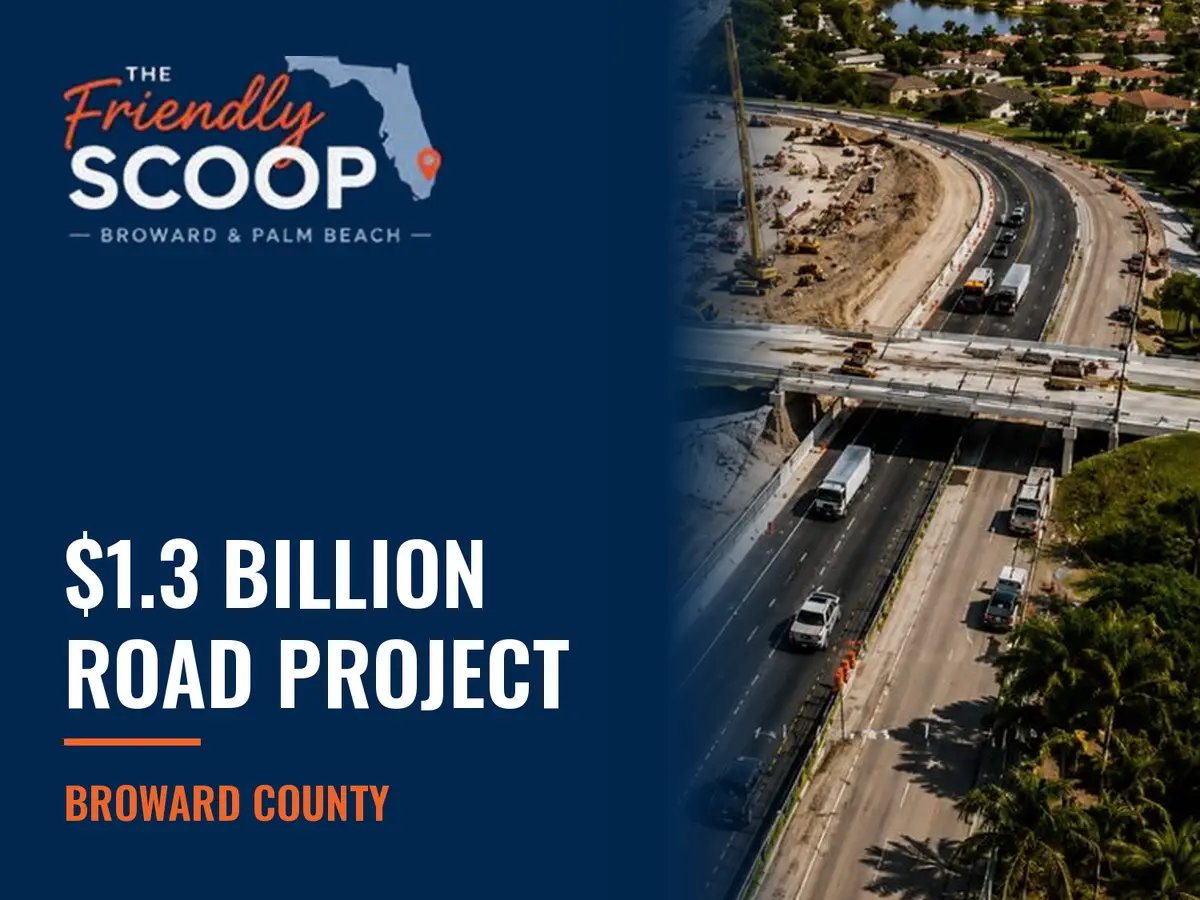
The $1.3 Billion Road Project About to Reshape How You Get Around
After nearly four decades of planning, the $1.3 billion SW 10th Street Connector breaks ground in summer 2026. Here is what it means for your commute, your evacuation route, and your property value across Deerfield Beach, Coconut Creek, Coral Springs, Parkland, and Boca.
Jump to a section
- Four decades of waiting is almost over
- The problem this solves
- What they are actually building
- The timeline, and the pain points to plan around
- What it means for your commute
- What it means for your property value
- The bottom line
- Quick Reference
- Frequently Asked Questions
Four decades of waiting is almost over
If you have ever crawled east on SW 10th Street off the Sawgrass at 5 p.m., watching regional traffic and local traffic strangle each other on the same three miles of road, you already understand this project without reading another word.
After nearly 40 years of planning, the Florida Department of Transportation is finally building the SW 10th Street Connector, a $1.3 billion reconstruction of the corridor between the Sawgrass Expressway and I-95 in Deerfield Beach. Early construction starts in late summer 2026. Major construction follows in summer 2027. The finish line is 2032.
That is a long runway, and it is going to be a bumpy one. But when it is done, it changes how a huge slice of northern Broward gets around, and it touches five communities at once: Deerfield Beach, Coconut Creek, Coral Springs, Parkland, and the northern edge of Boca Raton. If you live, work, or own property anywhere near this corridor, here is what is actually coming, when, and what it means for your daily drive and your home's value.
The problem this solves
Here is the core issue in one sentence: a regional highway and a neighborhood street are currently the same road, and neither works.
The project is the marquee local piece of Moving Florida Forward, the state's multibillion-dollar infrastructure initiative - which is the reason the funding is finally in place after decades of sitting on paper.
SW 10th Street is a three-mile arterial that quietly does double duty as the eastern tail of the Sawgrass Expressway (State Road 869), funneling turnpike and Sawgrass traffic, including heavy freight, onto a local Deerfield Beach street roughly two miles before it reaches I-95. So the same stretch of pavement is asked to serve commuters racing between two expressways and residents trying to reach their own driveways and local businesses. The result is the daily bumper-to-bumper mess everyone in the area knows by heart.
FDOT's own numbers put a hard figure on it: without the project, the average commuter through this corridor would eventually sit in traffic up to 30 minutes every evening rush, which adds up to as much as 130 hours a year. That is more than three work weeks, spent idling.
This corridor was actually envisioned as a limited-access regional connection back in the 1970s, and the state bought the land for it in the 1980s. It just never got built. The missing link has been sitting there, on paper, for a generation.
What they are actually building
The central idea is elegant: stop making one road do two jobs. Split it in two.
Two separate roadway systems along SW 10th Street:
- Dedicated connector lanes for regional traffic between the Sawgrass Expressway and I-95 - separated from the local street and running elevated over major cross streets like Powerline Road and Military Trail. This is where the through-traffic and freight go, bypassing the neighborhoods entirely.
- A rebuilt local SW 10th Street, redesigned as a "Complete Street" that serves the homes and businesses along the corridor, with local lanes posted at 35 mph, enhanced lighting, and a 12-foot shared-use path for pedestrians and cyclists.
The two roads work in parallel. Regional drivers get a clean run between the expressways. Local residents get their street back, minus the freight trucks.
On I-95 itself, within the project limits:
- The 95 Express lanes double, going from one lane to two in each direction between Sample Road and Hillsboro Boulevard.
- The SW 10th Street interchange at I-95 is fully reconfigured with new direct-connection ramps, and the Hillsboro Boulevard interchange gets ramp and intersection upgrades.
- New flyover ramps connect the corridor to I-95.
- The NW/NE 48th Street bridge over I-95 is fully rebuilt - one of seven bridges reconstructed across the corridor for storm resilience.
FDOT selected two contractor teams to deliver it: Prince OHLA JV (a joint venture of Prince Contracting and OHLA USA) and Archer Western, working under a design-build method that lets the scope flex as construction realities shift.
The timeline, and the pain points to plan around
This is a multi-year build delivered in phases, deliberately sequenced to keep as much traffic moving as possible. Here is the shape of it.
Early 2026: the walls go up first. The first visible work on the corridor is the construction of noise barrier walls. Nearly all the communities along the route qualified for them, and neighborhoods along the Waterways corridor, including Century Village East, were surveyed for the barriers. Those walls are the first thing you will see change.
Late summer 2026: early construction begins. One of the first major components is the reconstruction of the NW/NE 48th Street bridge over I-95. This is the one to circle on your mental map, because a bridge reconstruction of this kind means an extended closure of that crossing, on the order of about a year. If NW/NE 48th Street is part of your routine, start thinking now about your detour.
Early construction runs in three packages - the noise walls, the NW/NE 48th Street bridge reconstruction, and utility relocation along the corridor (coordinated with Deerfield Beach, Broward County Water & Wastewater, FPL, TECO Peoples Gas, Comcast, and AT&T).
Summer 2027: major construction. This is when the heavy, corridor-wide work ramps up and when drivers will feel the most disruption. Expect lane shifts, nighttime work, and periodic short-term closures at specific work points.
Through 2032: phased completion. Individual segments finish on a rolling basis. FDOT has committed that all local side streets and driveways stay open throughout construction, with the exception of short-term closures right at specific crossing points, and that access to local businesses will be maintained, with closures communicated in advance.
A note for the small businesses along the corridor: this is the hard part. Multi-year roadwork in front of your storefront is genuinely tough, and at least one business along the corridor has said it plans to leave when its lease ends, citing construction and customer access. If you run a business on this stretch, the FDOT community outreach process is worth engaging with early rather than late.
What it means for your commute
Let's get to the number everyone wants. FDOT projects that once the corridor is complete, routing non-local traffic onto the dedicated connector lanes will cut peak-hour travel time by up to 8 minutes for local traffic and as much as 14 minutes for highway traffic versus today.
Eight to fourteen minutes may not sound life-changing on paper, but if you drive this corridor daily, you know what those minutes are worth at 5 p.m. with a kid to pick up. Over a year, shaving even eight minutes off a daily round trip gives back real time.
The bigger structural win is the I-95 express lane expansion. Doubling 95 Express from one lane to two in each direction between Sample and Hillsboro closes a genuine bottleneck in the regional network, and that benefit reaches well beyond the immediate corridor, to anyone in Coral Springs, Parkland, or Coconut Creek who feeds onto I-95 through this stretch.
There is also a safety and resilience angle that gets overlooked. SW 10th Street is a designated hurricane evacuation route. Separating regional from local traffic and improving the interchanges measurably improves how this corridor performs when a storm is bearing down and everyone needs to move at once. In South Florida, that is not a footnote. That is a real quality-of-life and safety upgrade, and it ties directly into why so many residents backed the project despite the years of construction ahead.
What it means for your property value
This is where it gets interesting for homeowners, and where the honest answer is: it depends heavily on where your property sits relative to the work.
The near-term reality. During construction, proximity to active roadwork is a drag. Noise, dust, detours, and the general disruption of a multi-year project are not selling points, and buyers price that in. If you are thinking of selling a home immediately adjacent to the corridor in the thick of the 2027 to 2029 window, understand that the construction is a factor a buyer will weigh, and price accordingly.
The long-term reality is the opposite, and it is the part that matters more. Infrastructure that reduces congestion and improves connectivity is, over time, a value driver. A finished corridor that gives residents their local street back, adds a 12-foot shared-use path for walking and biking, puts noise walls between homes and the highway, and cuts commute times is a more desirable place to live than the congested mess that exists today. The neighborhoods that voted for those noise walls understood exactly this tradeoff: endure the build, gain the buffer.
The nuance that separates a good decision from a bad one. Not every address near this project is affected the same way. A home that backs directly onto the corridor experiences this very differently from one three streets in that gains the commute benefit without the noise-wall-adjacency. Improved access can lift values in one pocket while construction disruption temporarily softens another a block away. This is precisely the kind of hyperlocal detail that a general "the market is up" or "the market is down" headline completely misses, and it is worth understanding block by block before you buy or sell in this area over the next several years.
FDOT projects the corridor returns $4.26 in economic value for every $1 invested.
If you own near this corridor and are weighing a move in the next few years, the timing question is real and it is specific to your street. It is worth a genuine conversation rather than a guess.
Construction is the short term story. The longer one is what a project this size does to property values along the corridor. Homes by Cusi broke down what the connector means for North Broward home values.
The bottom line
The SW 10th Street Connector is one of the largest infrastructure investments northern Broward has seen in a generation, and after 40 years of waiting, it is finally real. The next six years will test the patience of everyone who drives this corridor. Noise walls in 2026, the 48th Street bridge closure starting in late 2026, heavy construction from 2027, and a 2032 finish.
But the payoff is a corridor that finally does what it was designed to do back in the 1970s: separate the through-traffic from the neighborhoods, move the region efficiently, give local residents a walkable street and a quieter backyard, and strengthen a critical evacuation route. For the five communities it touches, that is worth understanding now, whether you are planning your detours or thinking about your next move.
Quick Reference
| Detail | What to know |
|---|---|
| Project | SW 10th Street Connector (SR 869 to I-95) |
| Cost | $1.3 billion |
| Location | Deerfield Beach corridor, Sawgrass Expressway to I-95 |
| Communities affected | Deerfield Beach, Coconut Creek, Coral Springs, Parkland, north Boca |
| First visible work | Noise barrier walls, early 2026 |
| Early construction | Late summer 2026, including NW/NE 48th Street bridge |
| Major construction | Summer 2027 |
| Completion | 2032 |
| Travel time saved | Up to 8 min local, 14 min highway at peak |
| I-95 express lanes | Doubling from one to two each direction |
| Official info | sw10street.com |
| Funding program | Moving Florida Forward Infrastructure Initiative |
| Economic return | $4.26 per $1 invested (FDOT projection) |
The Friendly Scoop covers Broward and Palm Beach County. Project details are compiled from FDOT and local reporting and are subject to change as construction proceeds. For official schedules, closures, and updates, always confirm at sw10street.com.
Related Reading on The Friendly Scoop
🔗 The Broward Housing Squeeze: Why Finding a Single-Family Home Just Got Harder
🔗 Hurricane Season 2026: The Complete South Florida Homeowner's Prep Guide
🔗 Back to School 2026-27: The Complete Broward & Palm Beach County Guide
Frequently Asked Questions
When does construction start?
Noise barrier walls begin in early 2026. Early construction, including the NW/NE 48th Street bridge, starts in late summer 2026. Major construction follows in summer 2027.
When will it be finished?
Completion is expected in 2032, with individual segments finishing on a rolling basis before then.
Will the 48th Street bridge really close?
The NW/NE 48th Street bridge over I-95 is being fully reconstructed as an early component, which means an extended closure of that crossing. Plan alternate routes.
Will local roads and businesses stay open?
FDOT has committed that all local side streets and driveways remain open throughout construction, except for short-term closures at specific work points, and that business access will be maintained with advance notice of closures.
How much time will it actually save?
FDOT projects up to 8 minutes saved for local traffic and up to 14 minutes for highway traffic at peak hours, once complete.
Which neighborhoods are getting noise walls?
Nearly all communities along the corridor qualified. Century Village East, Waterford Homes, and The Enclave at Waterways were among those that voted in favor.
Where can I get official updates?
FDOT maintains project information and updates at sw10street.com.